Level 1 — Snapshot
Overview
Set your controls and click “Generate Plans” to get a one-page overview of
your LEGO 1939 Aston Martin Speed Model Type C — a sleek two-litre roadster
with deep aero fenders and a 100 mph pre-war top speed.
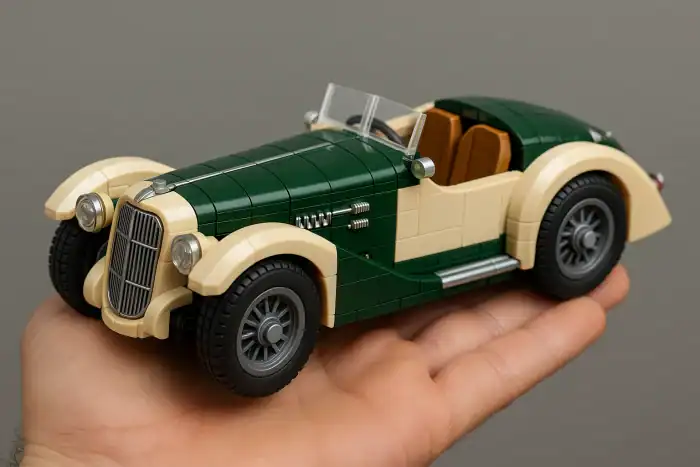
Generator for a LEGO recreation of Claude Hill’s 2-litre Speed Model Type C — the streamlined, alloy-bodied evolution of Aston Martin’s pre-war sports car, developed for aerodynamic efficiency and 100 mph performance.
Engineer Claude Hill created the Type C as the final and most advanced version of Aston Martin’s 2-litre Speed Model. His brief was simple: maximise aerodynamic efficiency while keeping the car small, light and competitive in sports-car racing. The result was a short-wheelbase, wide-track chassis wearing rounded, full-width front wings, recessed headlamps and a long, tapered tail.
Light-alloy main body panels were mounted over a steel frame, with the wings themselves fabricated in steel. This hybrid construction kept weight down while retaining strength for competition. The smooth nose and faired lamps were a sharp break from Aston Martin’s earlier cycle- wing cars and made the Type C look almost like a land-speed record machine.
Under the bodywork sat Hill’s 2-litre inline-four, a development of the earlier 1½-litre racing engine. In Speed-Model tune it used larger carburettors, high-lift camshafts and dry-sump lubrication, pushing output roughly a quarter higher than the earlier design and allowing genuine 100 mph performance in road-racing trim.
The chassis itself was shorter, wider and stiffer than previous Aston frames, with improved suspension and powerful brakes to cope with the extra speed. Period tests and Brooklands running showed at least one Type C reaching over 110 mph when geared and tuned for maximum speed, a serious figure for a two-litre car on pre-war tyres.
The Type C body style arrived in the late 1930s as Aston Martin sought a fresh look and faster customer cars. In total only eight Speed Models were completed with this distinctive bodywork before the Second World War halted production, making the Type C one of the rarest Aston Martins ever. Surviving examples are prized both for their racing pedigree and for their unusual, streamlined styling.
Disclaimer: Our real-world build plans are designed with the help of AI, and while we aim for accuracy, minor errors or inconsistencies may occur. Part fit, stability, colors, and availability may differ from renders, and some substitutions may be required. Use of any plans, generators, or files is at your own risk. TacoCat in Texas is not liable for issues arising from site use, and is not affiliated with or endorsed by LEGO®. Please verify suitability and safety before building.
The 1939 Aston Martin Type C stands out as a rare and historically important British competition car. It reflects the brand’s early sporting ambitions and specialist racing character.
Because of that, it remains a rewarding topic for readers who enjoy pre-war motorsport history.
Competition cars often reveal the true sporting identity of a brand. The Type C does that for Aston Martin in a focused and memorable way.
Unlike grand touring or luxury road cars, a competition car is shaped by the need to perform. That gives the Type C a more direct and serious personality.
As a result, it has a special place in Aston Martin history.
The 1939 Aston Martin Type C matters because it helps trace the roots of Aston Martin’s later sporting reputation. It remains a rare and valuable part of British racing heritage.
The 1939 Aston Martin Type C is rare, purposeful, and historically important. It stands as a strong example of early British competition ambition.